These features are currently in Private Preview. Please reach out to your Coalesce account manager to sign up.
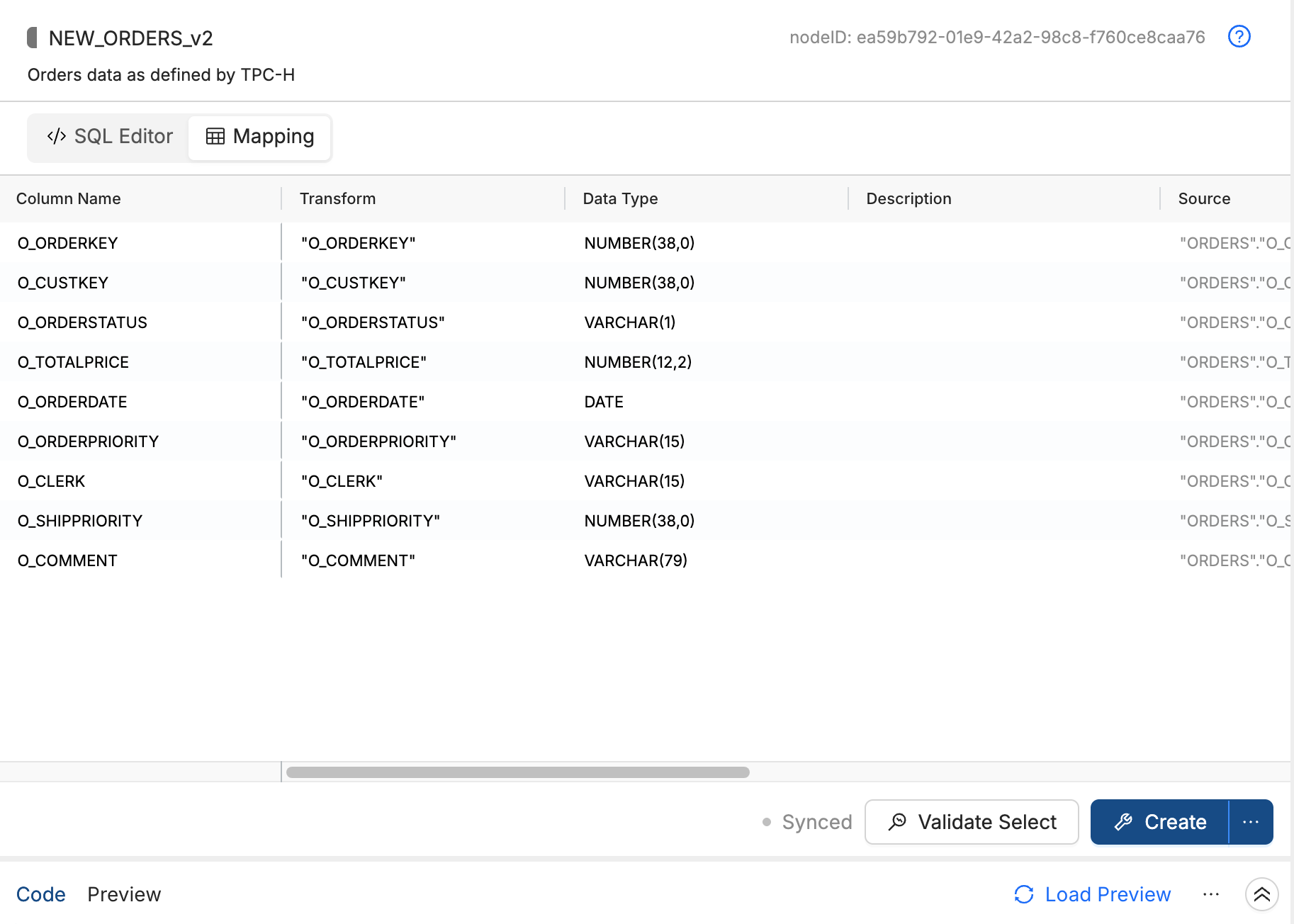
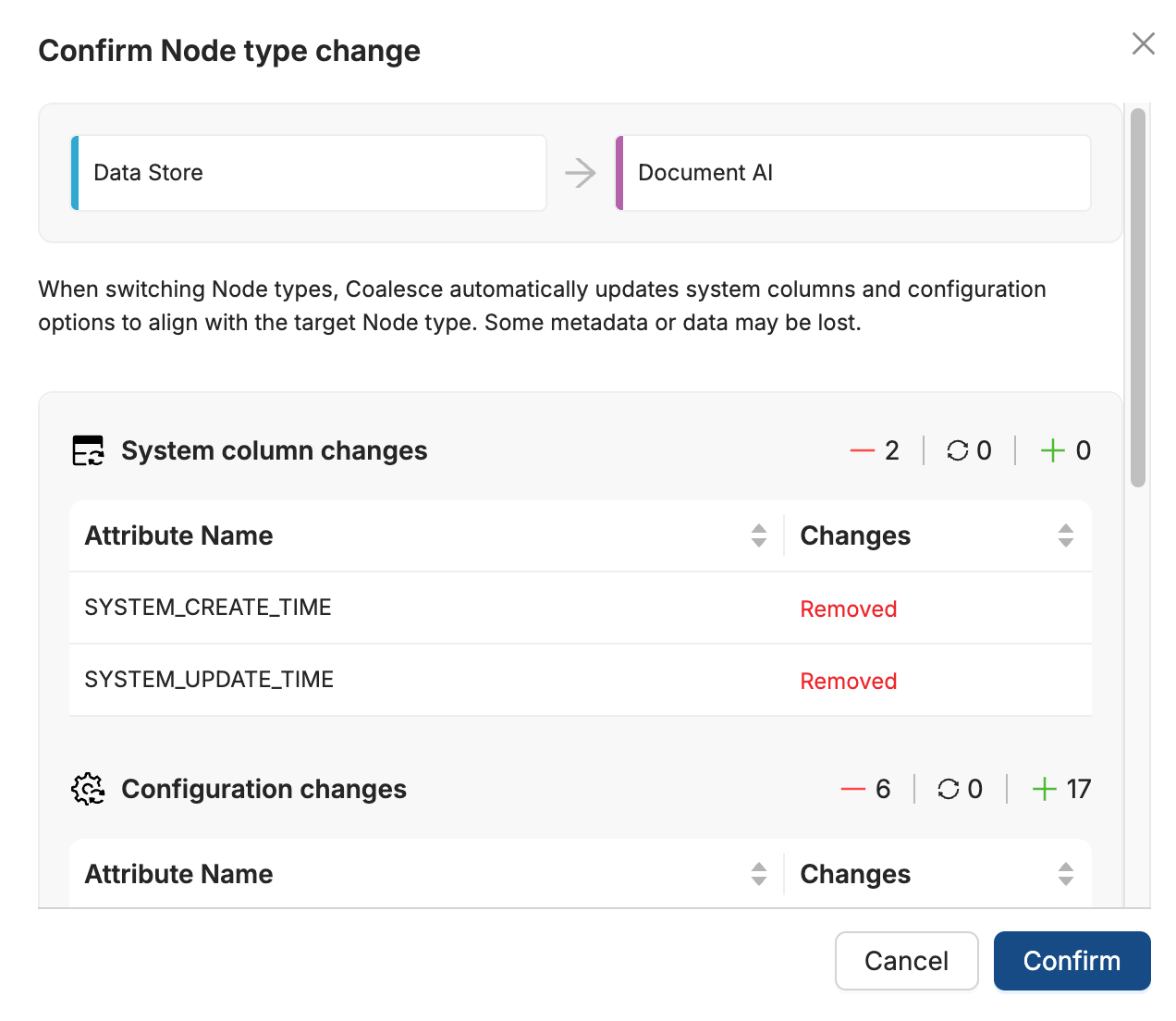
We've made significant improvements to Node type switching in Coalesce. When changing a Node's type (for example, from View to Dimension), Coalesce now performs a complete metadata reinitialization based on the target type definition. This ensures your Node fully adopts the target type's structure while intelligently preserving your work.
You can also now use the bulk edit to switch Nodes Types across multiple Nodes at once. Each Node displays its own preview, showing the specific metadata changes that will occur for that Node.
Starting with this release (7.28), we're rolling out updates in stages over the course of a week to ensure a smooth deployment for all customers. Your app will automatically receive the update as it becomes available. You don't need to take any action. We'll notify you once the release is live in your app. This staged approach helps us monitor each release and address any issues quickly, ensuring the best experience for everyone going forward.
Coalesce Copilot is an AI assistant that accelerates data pipeline development through natural language interaction. Instead of manually configuring nodes through the UI, simply describe your requirements in plain English or paste existing SQL—Copilot translates your intent into working DAG nodes with proper transformations, columns, and relationships. This intelligent assistant empowers teams to:
Build and modify nodes through conversational commands.
Import existing SQL queries into structured Coalesce pipelines.
Execute multi-step workflows from high-level requirements.
Receive guidance on best practices and workspace configurations.
By combining the speed of AI-generated scaffolding with the precision of Coalesce's visual interface, Copilot enables both experienced developers and SQL users to build production-ready data transformations faster than ever before.
Enable Coalesce Copilot in your Organization Settings > Preferences.
UI Changes
Improved Error Messaging for Timed Out Runs — Run timeout errors now say "Run timed out. Restart the run, and if this issue persists contact support." Run details now show whether you executed the run using the Coalesce App or Coa CLI in the new "Executed By" field.
Readable Add Source Popup After Workspace Creation — The popup that appears after creating a Workspace to guide you on adding sources now has improved text contrast. The message is now easy to read against the blue background.
Test Failure Indicator in Build Interface — When you run a Node with tests and a test fails with "Continue on Failure" enabled, you'll now see a visual indicator. An orange indicator appears on the Node, and a yellow indicator appears on the failed test child Node. This makes it easier to spot test failures without checking run details.
Mapping Grid
Prevent Accidental Empty Columns — The Mapping Grid no longer creates empty "nameless" columns when you click or tab through the grid. Previously, clicking in the grid could accidentally generate blank column rows without names or data types. You now need to take an explicit action to create new columns, reducing confusion and metadata clutter.
Bug Fixes
OAuth Token Storage Issue Resolved — Fixed a scenario where OAuth users with Snowflake connections could be blocked due to a secrets storage issue. The system was unconditionally saving Snowflake tokens in V1 format even when the V2 feature flag was enabled, causing payload size limits to be exceeded in Google Secrets Manager when tokens expired and needed to be reset.
Full Deploy History Access — Fixed an issue where some users with correct Environment Reader permissions could only view 2-4 recent deploys or runs in the Deploy tab. All users with Environment Reader permissions and above can now see the complete deployment history.
Node Descriptions Support for Databricks — Fixed an issue where adding a Node description to an existing Databricks Node would cause deployment failures. You can now add or update descriptions on Databricks Nodes without deployment errors.
Duplicate Column Errors — Fixed a scenario where the deployment process could generate ALTER statements to add columns that already existed, causing production deployments to fail. This issue occurred when certain column metadata changes triggered unnecessary ALTER statements.
Version 1.0.0 - The Coalesce Incremental load Node is a versatile Node that allows you to develop and deploy a Stage table/View in Databricks where we can perform incremental load in comparison with a persistent table added on top of it.
Version 1.0.0 - This package is inspired by the Great Expectations package for Python.It will allow you to deploy Great Expectations like tests in your data warehouse.
Version 3.0.1 - Added blank option to all optional dropdown selector configurations, improving usability. Test documentation updated.
Version 3.0.2 - Fixed Document AI stream name handling and added else blocks to prevent Empty SQL errors. Added default blank for Embedding model in Cortex Search Service.
Version 2.1.4 - Added common column dictionary list macro with logic improvements. Added blank options for Refresh and Initialize configurations.
Version 2.1.5 - Fix for Missing Handler for Incoming Node type transitions (View/Table → Dynamic Table).
Version 2.1.6 - Adds Advance Warehouse Selection, Immutability Constraint, and Backfill options across Work/Dimension/Latest Record Version. Updates redeploy/ALTER triggers and simplifies materialization-change steps.
Version 2.1.0 - Expands DMF node config to include Universal DMFs, Custom DMFs, and Alerting Options; adds static-behavior limitation; updates screenshots and versions table.
Version 2.2.0 - Enhanced delete logic for Fact and Dimension nodes with three distinct methods:
Hard Delete (permanent removal)
Soft Delete (marks records as isSystemCurrentFlag = 0 while retaining history)
No Delete (prevents delete operations to maintain existing data flows).
Added Primary Key management configuration for seamless altering and dropping of constraints.
Added Merge Exclude List for SCD Type 1, allowing specific columns to be excluded from the update phase of MERGE operations.
Version 2.2.1 - Fixed Empty SQL statement issue.
Version 2.3.0 - Added Last Modified comparison to Dimension, Persistent stage, and Fact Nodes.
Version 2.3.1 - Added Last Modified Comparison CDC options (including Last Modified Column, Treat Null as Current timestamp, and Type 2 Dimension note) across Persistent Stage (table/transient), Dimension (table/transient), and Fact (table/transient).
Version 3.0.3 - Added dictionary functionality for macros in Dynamic Iceberg Dimension and Dynamic Iceberg LRV node types. Fixed Empty SQL errors in Snowpipe Iceberg Table and External Iceberg Table.
Version 2.0.4 - Added case insensitive toggle to CopyInto, Snowpipe, and External Table node types. Modified run templates for Snowpipe, External Table, and InferSchema to fix Empty SQL errors. Modified External Table to not drop temporary file format in infer process.
Version 2.0.5 - Adds Snowflake Secrets-based credentials for API node (Bearer/Client ID+Secret) with guidance and images. Adds package tags and updates versions table.
Version 2.1.1 - Add Git Seet Node. Loads data files directly from Git repositories into Snowflake tables. It connects your version-controlled seed files including CSVs, reference tables, lookup data to your Coalesce pipelines without manual file transfers or separate staging infrastructure.
We’ve introduced caching to make deployment plans faster. The new Caching Deployment Plan feature reduces plan generation time by skipping SQL re-renders for Nodes that haven’t changed.
The feature can be enabled in two ways:
CLI flag:coa plan --enableCache
UI toggle: Available in the "Parameters" step of the deployment wizard.
Learn more about using deployment caching in our documentation.
Coalesce has introduced updates to improve metadata integrity across Nodes. Starting in the 7.24 release, null values in Node metadata are automatically removed.
When you commit changes, you may notice updates to Nodes that you haven’t directly modified. This is expected, since null fields are being removed. You should commit these changes and continue with your workflow.
What to Expect
Git Modal: You may see diffs in the git modal where null values are removed.
No additional action is required. Commit the changes when they appear to keep your project in sync.
Understanding how transforms connect back to their source columns is now clearer and more intuitive. This update reduces confusion in the mapping grid by showing source details alongside transforms, giving you a complete and accurate view of column lineage.
Key Improvements
Clear Source Visibility: When a transformation is applied, the corresponding column source details are displayed in a read-only, grayed-out format.
Hover for Full Details: Hovering over the source reveals:
The original table or alias used
All columns included in the transform
Automatic resolution of unqualified column names to their source tables
Hash Column Transparency: Hash columns now expand to show the list of underlying source columns.
Better Alias Handling: Joins using aliases now display clearer lineage, improving traceability.
Deployments should be clear, organized, and easy to follow. We’ve redesigned the Coalesce deployment experience to make it cleaner, more intuitive, and more informative. The new workflow improves everything from commit selection to error handling.
Key Improvements
Streamlined Interface: A cleaner deploy view with more space to review commits and deployment details before execution.
Tabbed Review Experience: Instead of collapsible menus, deployment changes are organized into clear tabs for Nodes, Subgraphs, Jobs, Mappings, Node Types, Macros, and Packages.
Detailed SQL Visibility: Quickly see what’s changing with at-a-glance summaries, then drill into step-by-step SQL changes for each affected element.
Improved Validation & Error Handling:
Parameter validation, for example, JSON format checks, surfaces issues before deployment begins.
Deployment-time issues, like missing or invalid Storage Locations, now have clearer error messages with actionable guidance to resolve them.
We're excited to announce the addition of User Management API and Git Account API endpoints.
User Management
Automate user provisioning workflows, implement bulk role assignments, and manage permissions across organizations, projects, and environments programmatically.
We’ve continued to improve the user experience by:
Adding alphabetical sorting for Storage Locations and Environments.
Sorting the Nodes Panel alphabetically while also considering the Storage Location name. For example, if both Nodes are named analytics_source, the one with the Storage Location of SRC would come before the one with TGT.
We've launched a new Workspace Onboarding Wizard to create a more intuitive and efficient setup experience in Coalesce. This step-by-step process guides you through configuring everything needed to start developing, including authentication, version control, and storage mappings. Our goal is to minimize configuration time so you can begin building data pipelines faster.
Key Improvements
The new Workspace Onboarding Wizard streamlines the creation and duplication of Workspaces with the following enhancements:
Reuse Configurations on Duplication: When you duplicate a Workspace, you can now choose to reuse its existing Storage Locations and Storage Mappings, allowing you to skip this configuration step.
Automate Setup When Branching: When creating a new branch, the wizard automatically imports Storage Mappings from the source branch's commit history, ensuring a seamless transition.
Ref functions now validate inputs during plan rendering. Empty strings or undefined values now throw clear errors identifying problematic Nodes when using the Coalesce App.
We fixed an error where users would get “Error installing package: failed to validate request body” when installing Nodes.
The Problem Scanner now returns the alert "Configure key pair in User Credentials tab” for missing Snowflake Key Pair credentials.
Fixed issue where data type changes to columns in Coalesce would not deploy when the target table contained unexpected columns in the data warehouse. Changes now deploy correctly.